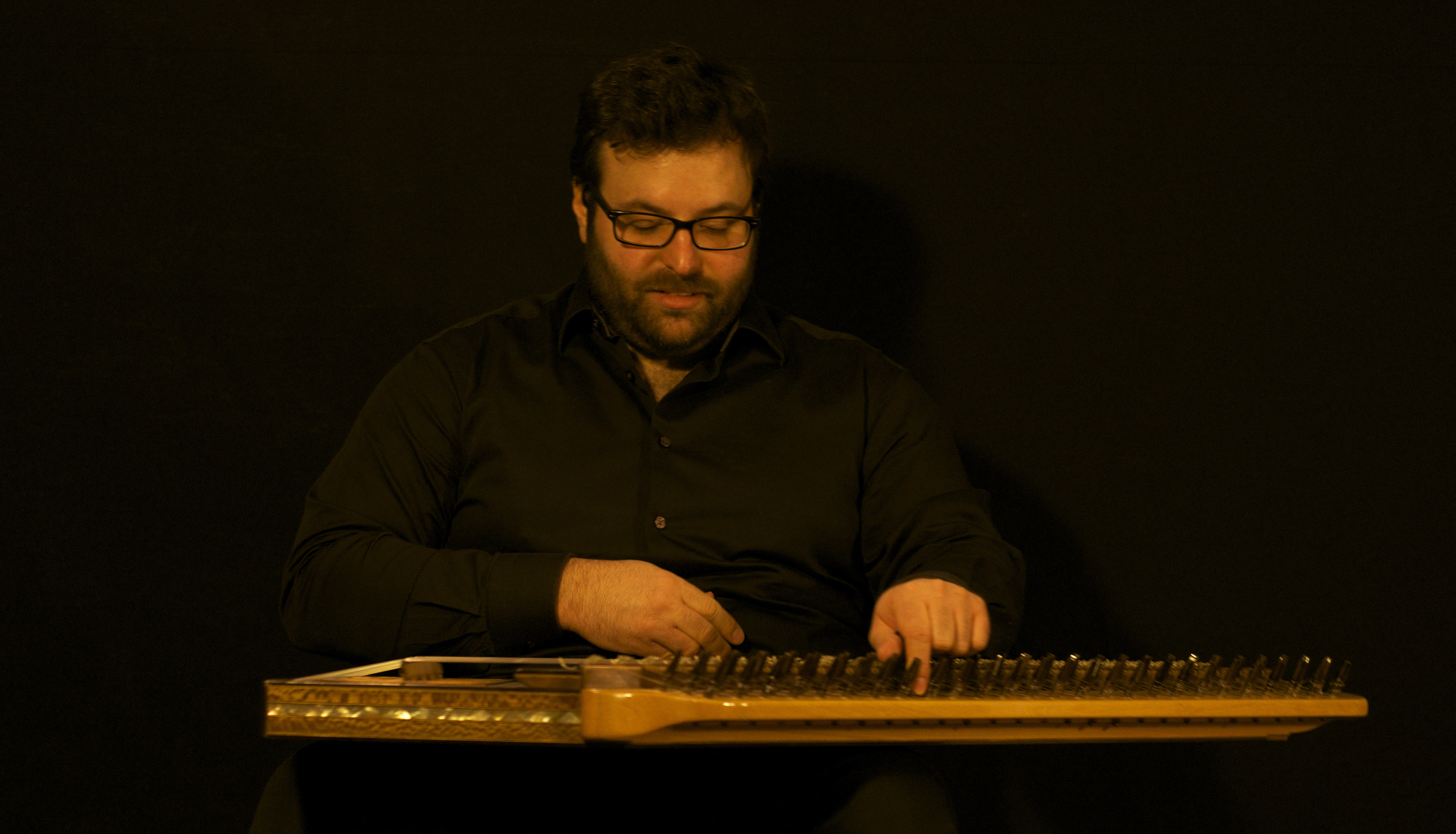
Spyros Halaris is a Greek multi-instrumentalist and singer specialising in the qanun and Constantinople lute, whose musical world spans Byzantine, Ottoman and early music traditions. His work brings together historical research, oral traditions and contemporary musical creation.
He has collaborated with artists such as his father Christodoulos Halaris, Kudsi Erguner and jazz saxophonist David El Malek, as well as with the Radio France Philharmonic Orchestra and the Hellenic Radio and Television Contemporary Music Orchestra.
He has performed with numerous early-music and traditional-music ensembles, including La Camera delle Lacrime, Les Jardins de Courtoisie, Amadis, Tormis, La Compagnie des Regains, Il Ballo, Obsidienne, Le Baroque Nomade, L’Achéron, Les Musiciens de Saint-Julien and Canticum Novum.
In 2012, he co-founded Ensemble Phemios and, in 2026, Evros Trio, alongside ney and kaval player Léa Maquart and percussionist Étienne Gruel.
A multi-instrumentalist and singer, and a performer on the qanun and various lutes, Spyros Halaris began his musical training by studying Byzantine chant with Nikos Konstantinopoulos, then continued with Spyros Pavlakis at the National Conservatory of Athens. At the same time, he studied the qanun with Panos Dimitrakopoulos and taught himself the oud as well as the Constantinopolitan lute (lavta).
Alongside his father, the composer and musicologist Christodoulos Halaris, he further developed his research into ancient Greek and Byzantine music. He has taken part in numerous concerts, recordings and television programmes with the “Orchestra of Delicate Instruments of the Ancient Greek and Byzantine Repertoire”, and has also been involved in European research projects within the cultural association Elliniki Mousourgia.
In France, he pursued studies in ethnomusicology at Université Paris VIII, trained in classical singing with Hubert Weller, and deepened his knowledge of Ottoman music with Adrien Espinouze within the Ensemble Sultan Veled. He completed his training through masterclasses with Efren Lopez, Eugenios Voulgaris, Halil Karaduman and Alexandros Kapsokavadis, and studied makam with Harris Lambrakis.
Beyond the Byzantine and Ottoman repertoires, his mastery of the qanun in its many traditions, together with his practice of lutes, has made Spyros Halaris a musician regularly sought after for artistic projects from a wide range of backgrounds. He has collaborated in particular with Kudsi Erguner, Nassima Chaaâbane, Christos Barbas, the Armenian Diaspora Chamber Orchestra, Christos Leontis and the Contemporary Music Orchestra of the Hellenic Radio-Television, as well as with jazz saxophonist David El Malek and the Orchestre Philharmonique de Radio France.
He also works with numerous early-music and traditional-music ensembles, including La Camera delle Lacrime, Les Jardins de Courtoisie, Amadis, Tormis, Canticum Novum, La Compagnie des Regains, Il Ballo, Obsidienne, Le Baroque Nomade, L’Achéron and Les Musiciens de Saint-Julien.
In 2012, he co-founded Ensemble Phémios with Sébastien Benoit and Christophe Tellart. The ensemble later welcomed Doc Rossi and collaborated with the Corsican singer Mighela Cesari.
In 2026, together with ney and kaval player Léa Maquart and percussionist Étienne Gruel, he formed Evros Trio, which explores art-music and popular repertoires at the crossroads of Greece, Bulgaria and Turkey.
Alongside his artistic activities, Spyros Halaris is also deeply involved in transmission and teaching within the association “École de l’Oralité”. He has led several workshops devoted to Greek and Byzantine music, notably “Byzantine modality and orchestration” at the Kreiz Breizh Akademi (2008, under the direction of Erik Marchand) and “Byzantine modes” at the Benedetto Marcello National Conservatory of Venice (2011). He has also been giving private qanun lessons since 2009.
Spyros Halaris est un musicien grec, multi-instrumentiste et chanteur, spécialisé dans le qanun et le luth de Constantinople, dont l’univers musical s’étend des traditions byzantines et ottomanes aux musiques anciennes. Son travail associe recherche historique, traditions orales et création musicale contemporaine.
Il a collaboré avec des artistes tels que son père Christodoulos Halaris, Kudsi Erguner et le saxophoniste de jazz David El Malek, ainsi qu’avec l’Orchestre Philharmonique de Radio France et l’Orchestre de musique contemporaine de la Radio-Télévision hellénique.
Il se produit au sein de nombreux ensembles de musique ancienne et traditionnelle, parmi lesquels La Camera delle Lacrime, Les Jardins de Courtoisie, Amadis, Tormis, La Compagnie des Regains, Il Ballo, Obsidienne, Le Baroque Nomade, L’Achéron, Les Musiciens de Saint-Julien et Canticum Novum.
En 2012, il cofonde l’Ensemble Phémios, puis, en 2026, le Trio Évros, avec Léa Maquart, joueuse de ney et de kaval, et Étienne Gruel, percussionniste.
Multi-instrumentiste, chanteur, joueur de qanun et de luths, Spyros Halaris débute sa formation par l’étude du chant byzantin auprès de Nikos Konstantinopoulos, puis la poursuit avec Spyros Pavlakis au Conservatoire national d’Athènes. Il y étudie parallèlement le qanun auprès de Panos Dimitrakopoulos et découvre en autodidacte le oud ainsi que le luth de Constantinople (lavta).
Aux côtés de son père, le compositeur et musicologue Christodoulos Halaris, il approfondit ses recherches sur la musique grecque antique et byzantine. Il participe à de nombreux concerts, enregistrements et émissions de télévision avec l’«Orchestre d’Instruments Délicats du Répertoire Grec Ancien et Byzantin » mais aussi des programmes de recherche européens au sein de l’association culturelle Elliniki Mousourgia.
En France, il poursuit des études d’ethnomusicologie à l’Université Paris VIII, se forme au chant lyrique auprès d’Hubert Weller et approfondit la musique ottomane avec Adrien Espinouze au sein de l’Ensemble Sultan Veled. Il complète son parcours par des masterclasses avec Efren Lopez, Eugenios Voulgaris, Halil Karaduman et Alexandros Kapsokavadis. Il prend des cours de makam avec Harris Lambrakis.
Au-delà des répertoires byzantin et ottoman, sa maîtrise du qanun dans ses multiples traditions, ainsi que sa pratique des luths, font de Spyros Halaris un musicien régulièrement sollicité pour des projets artistiques d’horizons différents. Il collabore notamment avec Kudsi Erguner, Nassima Chaaâbane, Christos Barbas, l’Orchestre de chambre de la diaspora arménienne, Christos Leontis et l’Orchestre de musique contemporaine de la Radio-Télévision hellénique, ainsi qu’avec le saxophoniste de jazz David El Malek et l’Orchestre Philharmonique de Radio France.
Il travaille également avec de nombreux ensembles de musique ancienne et de musiques traditionnelles, parmi lesquels La Camera delle Lacrime, Les Jardins de Courtoisie, Amadis, Tormis, Canticum Novum, La Compagnie des Regains, Il Ballo, Obsidienne, Le Baroque Nomade, L’Achéron et Les Musiciens de Saint-Julien.
En 2012, il cofonde l’Ensemble Phémios avec Sébastien Benoit et Christophe Tellart, formation qui accueille par la suite Doc Rossi et collabore avec la chanteuse corse Mighela Cesari.
En 2026, avec Léa Maquart joueuse de ney et kaval et le percussionniste Étienne Gruel il forme le Trio Évros qui explore les répertoires savants et populaires au croisement de la Grèce, de la Bulgarie et de la Turquie.
Parallèlement à ses activités artistiques, Spyros Halaris mène un travail de transmission au sein de l’association « Ecole de l’oralité ». Il a animé plusieurs stages consacrés à la musique grecque et byzantine, notamment « La modalité et l’orchestration byzantine » à la Kreiz Breizh Akademi (2008, direction Erik Marchand) et « Les modes byzantins » au Conservatoire national de Venise « Benedetto Marcello » (2011). Il dispense également des cours particuliers de qanun depuis 2009.